
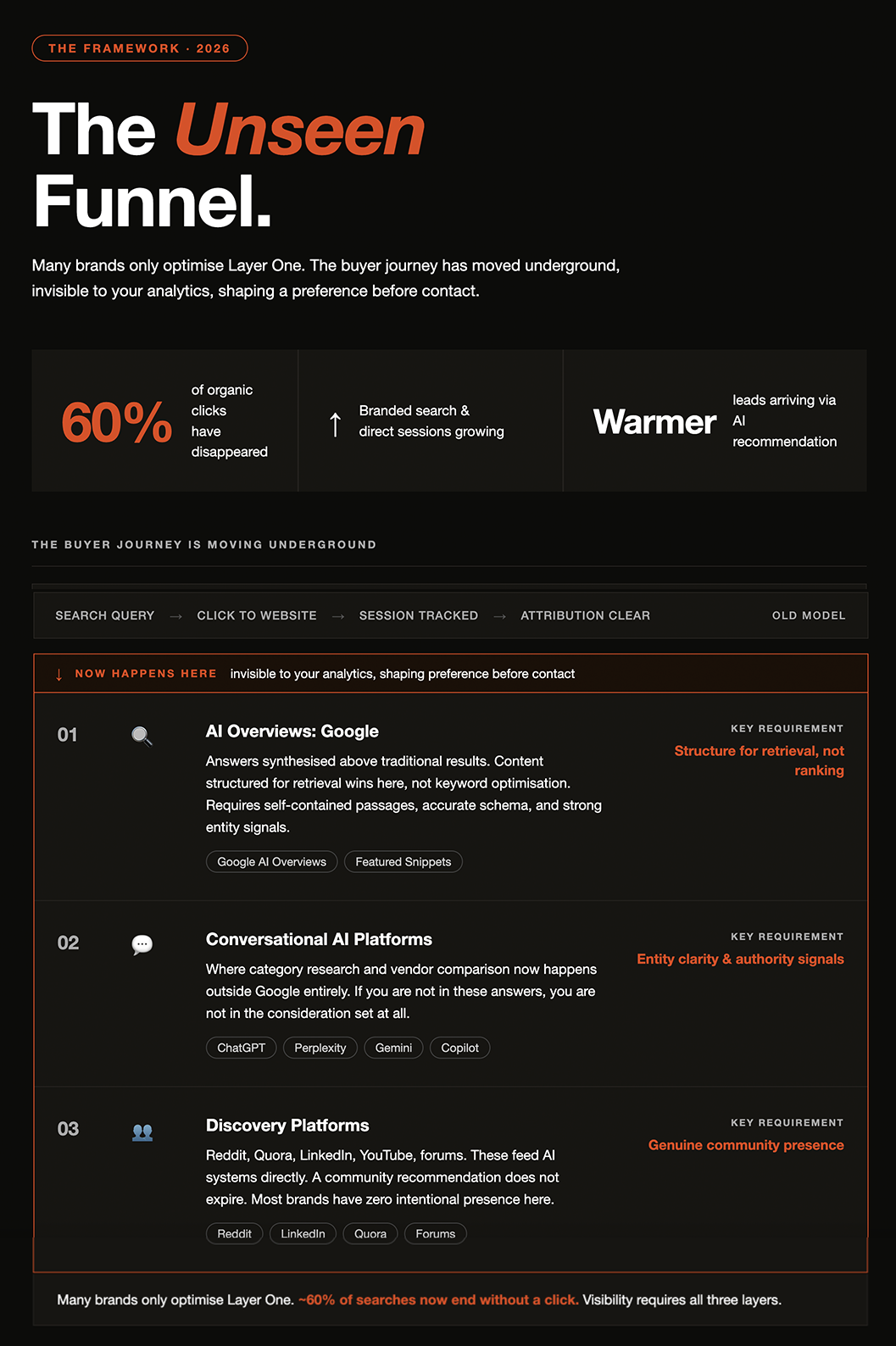
60% of the organic clicks that businesses relied on three years ago no longer happen. The query fires. The AI answers. The user moves on. No click. No session. No attribution. No evidence, as far as most analytics dashboards are concerned, that anything took place at all.
That disappearance of evidence is being mistaken for a disappearance of influence. It is not the same thing.
The purchase funnel has not contracted. It has gone underground. AI-generated answers, brand citations in ChatGPT and Perplexity responses, presence in the Reddit threads that feed those answers, mentions in the communities where buyers form opinions before they even know they are forming them — this is where the conversion work is now being done. It just does not show up in Google Analytics.
The brands treating the click drop as a crisis are solving the wrong problem. The real question is not how to recover lost traffic. It is how to be present in the places that are replacing it.
Working with a health and fitness client on a freelance project recently, the pattern became immediately clear. Organic sessions were down 34 percent year on year. The client’s leadership team, and the agency before them, had assumed something had broken. A penalty. A technical issue. The kind of problem with a clean diagnosis and a fix. What the data showed, once AI Overview presence and branded search volume were mapped alongside the traffic decline, was a different picture entirely. Branded search queries were up 18 percent over the same period. Direct sessions had grown across three consecutive quarters. The business was being mentioned in AI-generated answers to category-level queries. People were finding the brand through AI, forming a view, and arriving later through a different door. The funnel had not shrunk. It had changed shape.
Why the Click Was Never the Conversion
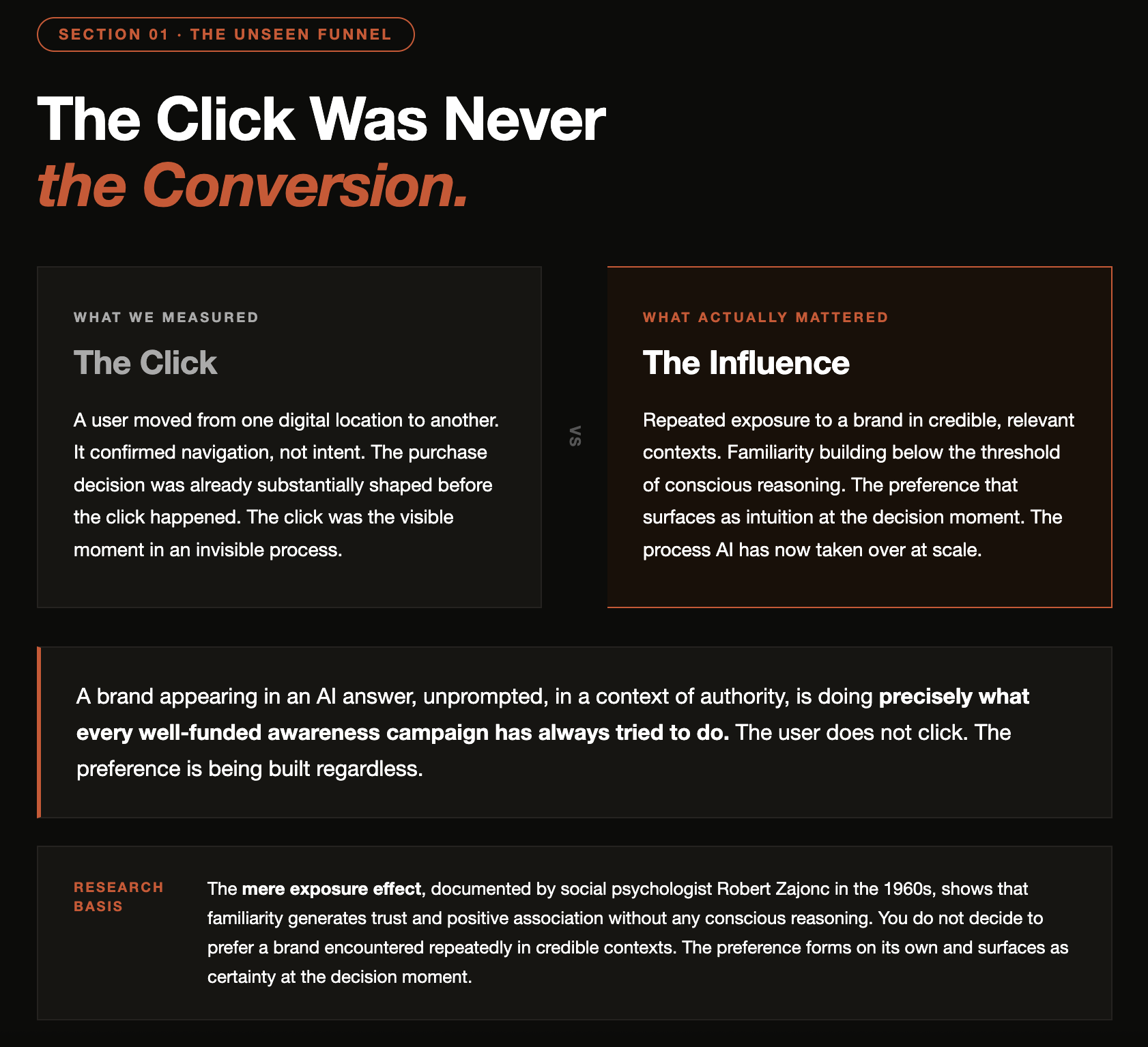
The click was always a proxy metric. The industry treated it as a primary one for so long that the distinction was forgotten. A click confirmed that a user had moved from one digital location to another. It did not confirm intent, readiness to buy, or the degree of influence that preceded it. In most categories, the purchase decision was already substantially shaped before the click happened.
Research into how the brain builds preference through repeated exposure tells us what experienced marketers have always sensed. The mere exposure effect, documented extensively in cognitive psychology, describes the process by which familiarity itself generates trust and positive association, without any conscious reasoning taking place. A brand that appears in an AI-generated answer, unprompted, in a context of authority, is doing precisely what repeated brand exposure has always done. It is building recognition. The user does not click. But they have encountered the name in a moment that matters. When the decision point arrives, that brand has an advantage that cannot be traced to a session or a source in any analytics platform currently available.
The Unseen Funnel is a structural description of how this influence now moves through the buyer journey when AI is the first point of contact with a category. It is not a metaphor. It is a mechanism.
What the Traffic Drop Is Actually Telling You
A 40 to 60 percent decline in organic clicks sounds like a catastrophe. Measured in isolation, against last year’s traffic benchmarks, it reads as one. Measured in context, against what has replaced those clicks in the buyer journey, it is something more precise.
Research from SparkToro and Datos, published in 2024, confirmed that more than 58 percent of Google searches already ended without a click to any website before AI Overviews became the dominant search feature they are today. AI Overviews accelerated a trend that was already structurally embedded. The clicks that have disappeared were predominantly informational queries, the top-of-funnel traffic that built awareness but rarely converted directly. What AI has done is absorb that awareness function into its own interface.
The implication is uncomfortable for any business that built its organic strategy around traffic volume as the primary success metric. But it is clarifying for any business willing to ask the right follow-up question. If AI is now handling the awareness layer of the funnel, the question is not how to get those clicks back. It is whether your brand is present, credible, and correctly understood in the AI layer that is doing the awareness work.
You cannot reclaim a function that has moved to a different interface. You can only show up in that interface. The AI Visibility Snapshot is the fastest way to find out whether you currently do.
The Three Places the Unseen Funnel Actually Lives
The Unseen Funnel operates across three distinct layers, and most brands are present in none of them intentionally. The first is AI Overview presence within Google search. The second is ChatGPT, Perplexity, and Gemini responses to category-level, comparison, and recommendation queries. The third is the community platforms, Reddit threads, forums, LinkedIn discussions, and sector-specific spaces, that feed both of the above as source material.
Each layer operates on different logic. AI Overviews pull from indexed content that has been assessed as authoritative and directly relevant to the query. A brand whose content is structured with clear, self-contained answers to specific questions, marked up with accurate schema, and associated with strong entity signals, is significantly more likely to appear. This is the AI retrieval dimension of the search visibility framework, and it is the layer most audits still do not formally assess.
ChatGPT and Perplexity synthesise from a broader range of sources, including web content and, increasingly, community platforms. A brand that is genuinely discussed in the spaces where its buyers gather, cited by practitioners, referenced in threads, and associated with specific solutions to specific problems, carries a different kind of signal weight in these systems than a brand that exists only as a collection of well-optimised landing pages.
The community layer is where most brands have the largest and least-addressed gap. It is also where the influence is most durable. A recommendation in a Reddit thread about the best health and fitness services in a specific city does not expire. It does not get displaced by a competitor’s ad spend. It continues feeding AI-generated answers about that category for months, sometimes years, after it was written. The most enduring visibility is built through genuine relevance in the communities that buyers trust, not through algorithmic compliance alone.
Stay ahead of it.
Weekly intelligence for marketing leaders navigating the shift from SEO to AI retrieval. Practical, senior-level, no filler.
No spam. Unsubscribe any time.
Understand where your brand stands in the Unseen Funnel
The free AI Visibility Snapshot maps your presence across Traditional Search, AI Overviews, and AI search, and tells you exactly where the gaps are.
The Counterargument: Traffic Still Pays the Bills
The obvious objection to this argument is legitimate and deserves a direct answer. Traffic converts. Revenue comes from visitors who arrive on the site, not from users who encountered a brand name in an AI answer and moved on without clicking. The Unseen Funnel is an interesting theoretical model, but it does not appear in a revenue report.
Here is the direct answer. The brands experiencing the steepest and most damaging traffic declines in 2025 and into 2026 share a specific profile: their organic strategy was built almost entirely on high-volume informational content designed to capture top-of-funnel awareness clicks. That model worked when Google served ten blue links and the first three positions captured the majority of available clicks. In a world where an AI Overview sits above those positions and answers the query without requiring a click, that content model has lost its primary distribution mechanism. The traffic was never the asset. The awareness the traffic created was the asset. AI has simply taken over the delivery of that awareness.
The brands holding their revenue through the same period share a different profile. They have strong transactional and navigational query presence, where user intent is specific enough that clicks happen regardless of AI answers. They have branded search volume that reflects genuine market recognition. And increasingly, they have AI search presence that is routing buyers to them through channels that do not register as organic sessions in GA4, but do register as revenue.
Traffic and revenue were always correlated, not synonymous. The AI era is making that distinction, which practitioners have known for years, uncomfortably visible inside organisations that built their reporting around session volume as a business metric.
Measuring a Funnel You Cannot See
The measurement problem is real, and it is the dimension of this shift that is most practically difficult for marketing teams to resolve internally. GA4 does not have an AI mention source. Search Console does not report impressions in ChatGPT. The data that would confirm the Unseen Funnel’s contribution to revenue does not yet exist in a clean, dashboard-ready format.
What does exist is a set of proxy signals that, read together, describe influence even when the click is absent. They require a different reporting framework, but they are measurable now with tools that most in-house teams already have access to.
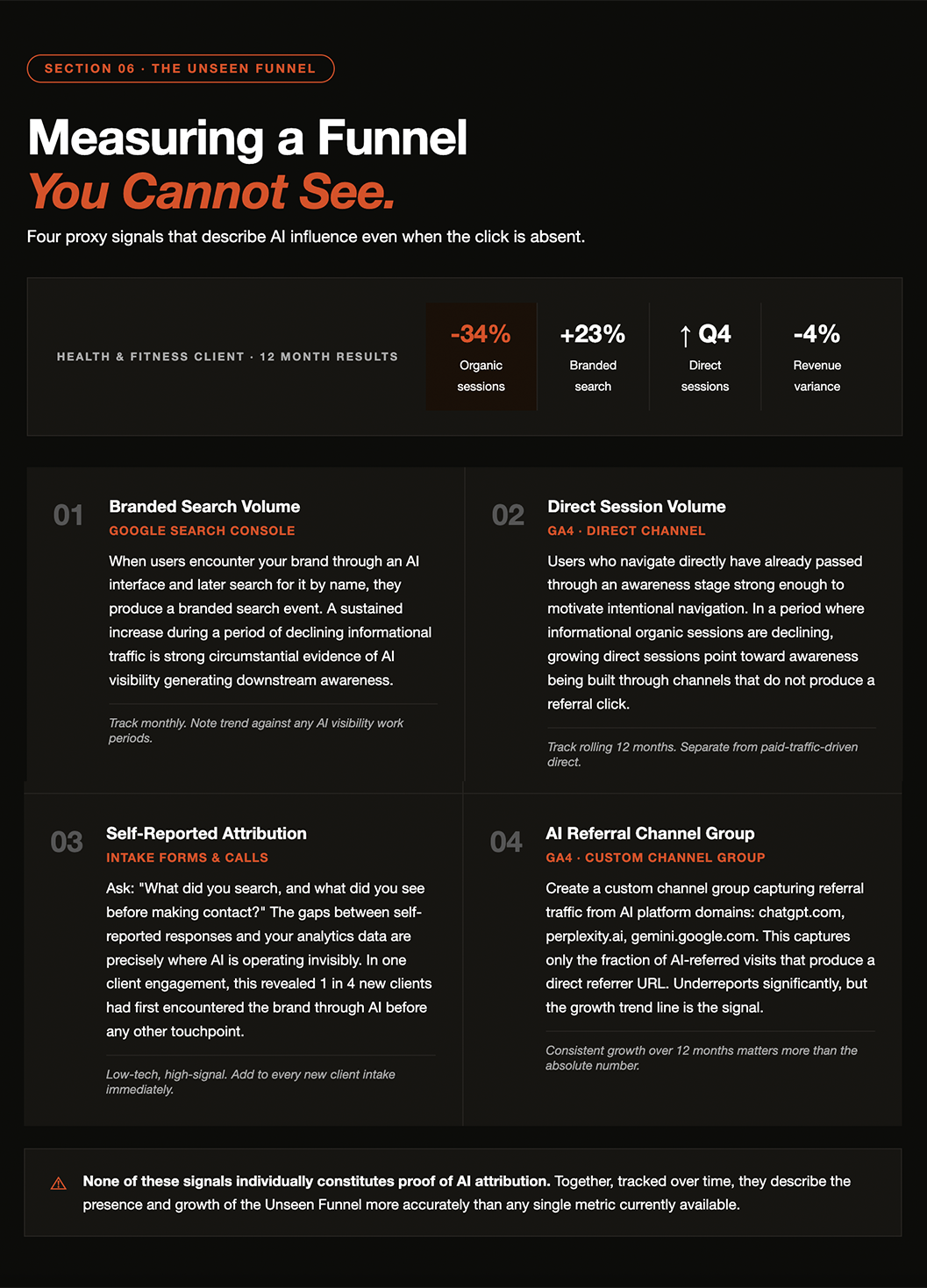
Branded search volume is the clearest indicator. When users search for a brand name directly, without a category qualifier, it means they already know the brand exists and have formed enough of a preference to seek it out specifically. That recognition came from somewhere. In a period of declining organic click volume, AI mentions and community platform presence are the most probable sources, and the correlation between AI search growth and branded search lift is something that can be tracked month on month.
Direct session volume tells a related story. A user who navigates directly to a site has already passed through an awareness stage that left a strong enough impression to motivate that navigation. This is not accidental. It is the downstream evidence of upstream influence.
The health and fitness client rebuilt their reporting framework around these three signals after traditional traffic metrics became structurally misleading. Twelve months in, branded search was up 23 percent, direct sessions had grown for the fourth consecutive quarter, and revenue from organic-attributable sources was within four percent of the prior year, despite a 34 percent drop in organic sessions. The funnel had not disappeared. It had moved. The measurement framework had to move with it. That reframing of what counts as evidence of search success is precisely what the AI Visibility Strategy Audit is designed to produce.
The 8 Metrics That Replace Your Old Dashboard
Most marketing teams track SEO religiously. Rankings, clicks, impressions, organic sessions, these numbers get reviewed weekly, reported monthly, and used to justify annual budgets. Almost none of those teams track AEO or GEO with the same rigour. That gap is about to become a board-level problem, because AI search is no longer emerging. It is already shaping which brands get recommended, which sources get cited, and where high-intent buyers arrive first.
The eight metrics below are not a replacement for what you already track. They are the layer your current dashboard cannot see, the one that describes what is happening in the funnel before the click occurs. Each one is measurable now, without new analytics platforms, and each one maps directly to commercial outcomes rather than traffic volume. Together they give any marketing leader something concrete to take into a quarterly review: a picture of AI search visibility that translates into business language.
1. AI Citation Rate. How often your brand is cited across ChatGPT, Perplexity, Gemini, and Google AI Overviews when buyers search your category. This is the most direct indicator of AI search visibility, the closest equivalent to a ranking position in traditional SEO. Track it by running your core category queries monthly and logging whether your brand is named, linked, or absent. It is the number that tells you whether AI knows you exist. The AI Citation Checker makes this process systematic rather than manual.
2. Share of Voice in AI Responses. Citation rate tells you about your brand in isolation. Share of voice tells you how your brand compares to competitors in the same AI-generated responses. Search your core category queries and note which brands are recommended alongside yours, or instead of yours. Track this monthly. Competitive shifts in AI share of voice often precede competitive shifts in revenue by a quarter or more.
3. AI Visibility Score. A composite internal benchmark built from citation rate, mention frequency, brand sentiment, and platform coverage across the AI tools most relevant to your buyers. The exact formula matters less than the consistency, set a baseline, review it quarterly, and track movement. This is your primary AI search health benchmark: the equivalent of domain authority for the AI era, and the number your board can understand without needing to know what a prompt is.
4. Brand Sentiment in AI Responses. When your brand does appear in an AI-generated answer, how is it described? Accurately? Positively? With outdated information? AI systems draw from whatever exists about your brand across their training data and live web sources. If the description is weak, generic, or factually wrong, that is a narrative gap, and one that compounds as those answers get read by buyers who will never visit your website to correct the impression. Search your brand name plus your core topics across multiple platforms and note exactly what the AI says. Inaccurate or absent descriptions require active correction through updated content, structured data, and entity signals.
5. Prompt Coverage. Of the 20 to 30 questions your buyers are most likely to ask an AI assistant before making a purchase decision in your category, how many produce an AI response that includes your brand? Build that prompt library, real customer questions, comparison queries, “best of” queries, problem-specific queries, and test them regularly. The gap between how many prompts mention you versus how many mention your strongest competitor is the most actionable number in this entire framework. The AI Visibility Snapshot uses exactly this methodology to map where your brand stands across the queries that matter most.
6. AI Referral Traffic and Conversion Rate. GA4 now captures identifiable referral traffic from ChatGPT, Perplexity, and Gemini. Track this separately from organic search and benchmark the conversion rate independently. AI referral visitors consistently convert at higher rates than average organic traffic, because they arrive having already received a recommendation rather than having simply found a result. That conversion differential is the number that makes the investment case to a sceptical finance director.
7. Schema and Technical Health Score. How many of your key commercial pages have the correct schema markup in place, Article, FAQ, Organisation, Product, LocalBusiness as appropriate? Are your robots.txt settings allowing GPTBot, PerplexityBot, ClaudeBot, and Google-Extended to crawl your site? What percentage of your important pages are technically accessible and machine-readable? This is the infrastructure layer of AI visibility. Without it, the content work above it underperforms regardless of quality. The AEO Readiness Checklist gives you a structured way to assess and address this layer page by page, and the AI Visibility Strategy Audit produces a prioritised action list of what to fix first.
8. Content Freshness Rate. AI systems weight recently updated content more heavily than static pages, because recency is a proxy for accuracy. Monitor the percentage of your key pages updated in the last 90 days. Pages under three months old are significantly more likely to be cited than pages untouched for a year. Set a quarterly content refresh cadence, build it into your editorial calendar, and track compliance monthly. It is the lowest-cost, highest-leverage maintenance task in an AI search strategy.
Most businesses are not tracking any of these. They are making visibility decisions based on rankings, clicks, and organic sessions alone, a complete picture of one part of the funnel, and a blind spot for everything that happens before it. Making the shift to this measurement framework does not require a new analytics platform. It requires a new set of questions, asked consistently, with results mapped against commercial outcomes rather than traffic volume.
What the Unseen Funnel Demands of Your Strategy in 2026
The practical demands of the Unseen Funnel are not complicated, but they do require a deliberate reallocation of where effort and investment go. The content and technical work that drives AI search presence overlaps with traditional SEO in some areas and diverges significantly in others.
For AI Overview and AI search presence generally, content needs to be structured for retrieval rather than for ranking. Self-contained answers to specific questions, accurate schema markup, clear entity signals that tell AI systems exactly what a brand is and who it serves, and a content architecture that matches the questions buyers are asking at each stage of their decision process. These are the foundations of AI visibility. They are also the areas most commonly absent from standard SEO audits, because the standard audit format was built to assess Google’s ranking algorithm, not the retrieval logic of a language model.
For community platform presence, the work is slower, less algorithmic, and more human. It requires genuine participation in the spaces where buyers gather, the kind of reputation that gets referenced rather than paid for. It cannot be scaled through automation without losing the quality that makes it legible to the AI systems that use those communities as source material. A sustained presence in two or three relevant communities, done with genuine intent over twelve months, will do more for AI search visibility than a hundred optimised landing pages written for keywords that AI Overviews now answer directly. If you are unsure where to start, the AI Visibility Strategy Audit maps your current position across every layer of the Unseen Funnel and tells you exactly where the highest-leverage gaps are.
Think about how music works as an influence mechanism. A track does not argue its way into your memory. It is present, repeated, associated with moments that carry emotional weight, until one day it is simply the thing you reach for without quite knowing why. The most effective brand presence in the AI era operates on exactly this principle. Not persuasion at the moment of click. Recognition at the moment of decision. The Unseen Funnel does not produce a trackable click path. It produces a felt preference that arrives at the purchase moment as near-certainty.
That is a fundamentally different strategy from winning the top ranking for a high-volume keyword. For most brands in 2026, it is a fundamentally better one.
Before the algorithm changed, there was always a human forming an opinion before they searched. There still is. The funnel was always unseen. AI has just made that fact impossible to ignore.
Start with a free AI Visibility Snapshot
Find out where your brand stands across all three layers of the Unseen Funnel – Traditional Search, AI Overviews, and AI search – in under 48 hours.
Frequently Asked Questions
What is the Unseen Funnel and how does it affect my business?
The Unseen Funnel describes the buyer journey that now happens before a click occurs, through AI-generated answers, brand mentions in ChatGPT and Perplexity, and community platform discussions that feed those AI systems. It affects your business because buyers are forming opinions about your brand and your category in spaces that do not register in your analytics, meaning revenue influence is happening invisibly while traditional traffic metrics decline.
Why are organic clicks dropping so significantly in 2025 and 2026?
Research from SparkToro and Datos found that more than 58 percent of Google searches were already ending without a click before AI Overviews became the dominant search feature. AI Overviews have accelerated this by answering informational and category-level queries directly within the search interface, removing the need for users to visit a website for the awareness stage of their buyer journey. The queries most affected are informational ones that built top-of-funnel traffic but rarely converted directly.
Does a drop in organic traffic mean a drop in revenue?
Not necessarily, and increasingly not directly. Traffic and revenue have always been correlated rather than synonymous. Brands maintaining revenue despite session declines are typically those with strong branded search volume, direct session growth, and AI search presence that routes buyers through different channels. The relationship between organic sessions and revenue is becoming less predictable precisely because the funnel has restructured around influence rather than clicks.
How can I tell if my brand is present in AI-generated answers?
Manual testing in ChatGPT, Perplexity, Google AI Overviews, and Gemini for your primary category, comparison, and recommendation queries is the most direct method available currently. The AI Citation Checker provides a more systematic approach to tracking this across multiple platforms and query types. Monitoring branded search volume and direct session trends in GA4 alongside citation testing gives a workable proxy picture of AI search presence and its downstream effects.
What content changes do I need to make to appear in AI search results?
Content needs to be structured for retrieval rather than for ranking. This means self-contained, direct answers to specific questions, accurate and complete schema markup, clear entity signals that define what the brand is and who it serves, and a content architecture that matches the questions buyers are actually asking rather than the keywords they are typing. The AEO Readiness Checklist walks through exactly what this looks like in practice. These requirements overlap with traditional SEO but have meaningful differences in emphasis.
Why does community platform presence matter for AI search visibility?
Community platforms including Reddit, Quora, LinkedIn, and sector-specific forums are used as source material by AI systems when generating answers. A brand that is genuinely discussed, recommended, and referenced in the communities where its buyers gather is significantly more likely to appear in AI-generated responses to category and comparison queries. This presence cannot be manufactured through automation at scale without losing the authenticity that makes it legible to AI retrieval systems.
What are the 8 metrics for measuring AI search visibility?
The eight metrics are: (1) AI Citation Rate, how often your brand is cited across ChatGPT, Perplexity, Gemini, and Google AI Overviews; (2) Share of Voice in AI Responses, how your brand compares to competitors in AI-generated answers; (3) AI Visibility Score, a composite benchmark across citation rate, mention frequency, sentiment, and platform coverage; (4) Brand Sentiment in AI Responses, how accurately and positively AI describes your brand; (5) Prompt Coverage, how many of your buyers’ likely queries produce AI responses that include your brand; (6) AI Referral Traffic and Conversion Rate, traffic and conversions from identifiable AI sources in GA4; (7) Schema and Technical Health Score, how many key pages have correct schema and are accessible to AI crawlers; (8) Content Freshness Rate, the percentage of key pages updated in the last 90 days. Together, these replace the traffic-first dashboard with one that describes visibility across the full funnel.
How should I report on search performance when clicks are declining but brand awareness may be growing?
Shift the reporting framework toward branded search volume growth, direct session volume trends, AI Overview impression data in Search Console, and revenue from organic-attributable sources tracked against prior periods. These signals describe influence even when clicks are absent. A brand with declining organic sessions but growing branded search and stable or growing revenue is experiencing the Unseen Funnel in action, not a search strategy failure.
How is the SEO strategy for AI search different from traditional SEO?
Traditional SEO prioritised ranking signals: backlinks, on-page optimisation, keyword targeting, and technical health assessed against Google’s ranking algorithm. AI search visibility requires all of those foundations plus entity clarity, passage-level content structured for retrieval, community platform presence, and brand signals strong enough for language models to understand and trust the source. The technical overlap is significant. The strategic emphasis is different. An audit designed for one will not adequately assess the other.
What should I do first if my organic traffic has dropped significantly this year?
Before diagnosing it as a technical problem or a penalty, map branded search volume and direct session trends against the traffic decline timeline. Then test AI Overview and AI search presence for your primary commercial queries manually. This will tell you whether the decline reflects a genuine visibility problem or a funnel restructure. The appropriate response to each is different, and treating a funnel restructure as a technical penalty wastes budget and time while the real gap compounds.
How do I make the case for AI search investment internally when the metrics are harder to attribute?
Frame the investment around branded search volume growth, direct session trends, and revenue stability rather than organic session recovery. The business outcome is the same, buyers finding and choosing the brand, but the mechanism has changed. Presenting AI search as a channel that has absorbed the awareness function previously performed by informational organic traffic, and showing the proxy metrics that confirm it is working, gives leadership a coherent picture that does not require the old metrics to behave the way they used to.
Founder & Author within Sticky Frog and creator of The Human Algorithm. 15 years of SEO experience spanning early-stage startups, scale-ups, and enterprise brands including Toyota Europe, Bupa, EY, Citibank, Deliveroo, and American Express, he specialises in AI search visibility, entity SEO, and search strategy for the era where clicks are declining but influence is not. Get found for what you do best.