
Google AI Mode is not an update. It is a restructuring of the entire value exchange between search and the web. For 25 years, the deal was simple: create content, rank for keywords, earn clicks. Google AI Mode has changed that deal. The question every marketing team needs to answer right now is not “how do we rank?” but “how do we get cited?”
I have been tracking this shift closely across client accounts and my own research, and the direction is clear. The brands winning in AI-driven search are not the ones who have mastered the old SEO playbook. They are the ones who have built the kind of recognised authority that AI systems trust enough to reference. Those are two different things, and confusing them is the most expensive mistake a marketing team can make right now.
I have spent 15 years doing enterprise SEO for brands including Toyota Europe, Bupa, EY, Citi, Square and American Express. In that time I have seen Google make significant shifts, Panda, Penguin, Hummingbird, Helpful Content. Each one changed tactics. This one changes the objective entirely. When I run AI visibility tests across client accounts now, the pattern is consistent: brands with genuine authority signals, third-party citations, structured entity definitions, distributed recognition across platforms appear in AI-generated answers. Brands without them are invisible regardless of their Google rankings. I have seen brands ranked #1 for their core commercial term fail to appear in a single AI-generated answer for the same query. That gap is what Google AI Mode has exposed.
What does Google AI Mode actually mean for SEO?
Google AI Mode places an AI-generated answer at the top of search results, synthesising information from multiple sources and citing them below the response. The user gets their answer immediately. They may never scroll to the organic results at all.
This represents a structural change in what Google is optimising for. Google is no longer primarily a navigation tool that directs users to websites. It is increasingly an answer engine that resolves queries before a click is necessary. The data bears this out: 57% of searches were already zero-click before AI Mode rolled out more broadly. That figure has continued to rise.
For SEO, this changes the primary success metric. If your goal is traffic, AI Mode is your adversary. If your goal is being the source AI Mode cites when answering questions in your domain, AI Mode is your distribution channel. The brands that understand this distinction are repositioning their entire content strategy around it. The ones that do not will find themselves producing content that ranks but generates no traffic, cited by nobody, and invisible to a growing share of how their audience gets answers.
What is the citation economy and why does it replace keyword rankings?
The citation economy is the name I use for the new value system in search, one where being referenced as a source carries more commercial value than holding a ranking position. This is not a new concept. Off-site authority has always been part of SEO. What Google AI Mode has done is make citation the primary outcome rather than a contributing factor.
In the old model, you ranked a page to get clicks. In the citation economy, you build authority to get cited. Those citations produce brand recognition at the moment a user’s query is resolved, before they ever click anywhere. The downstream effect is rising branded search volume, more direct traffic, and higher conversion rates from users who arrive with a pre-formed sense of your credibility. This is precisely what I have been tracking in client accounts: as AI citation rate increases, branded search volume follows.
Research from Airops shows brands are 6.5 times more likely to be cited by AI through third-party sources than through their own website. This is the foundation of the citation economy, it rewards distributed recognition over concentrated publishing. The brands appearing in AI-generated answers are not necessarily the ones who have published the most content. They are the ones who have been referenced most credibly across the web.
This connects directly to The Citation Economy framework and the Recognition Layer, the filter AI systems use to determine which entities are credible enough to cite. Both explain the mechanism behind what Google AI Mode has now made commercially critical.
What is the complexity moat and how do you build one?
One of the most actionable insights in understanding how Google AI Mode works is the relationship between query complexity and citation frequency. Short queries of three words or fewer trigger AI Overviews around 23% of the time. Medium queries of three to five words trigger them around 48% of the time. Long, complex queries of six words or more trigger them 77% of the time.
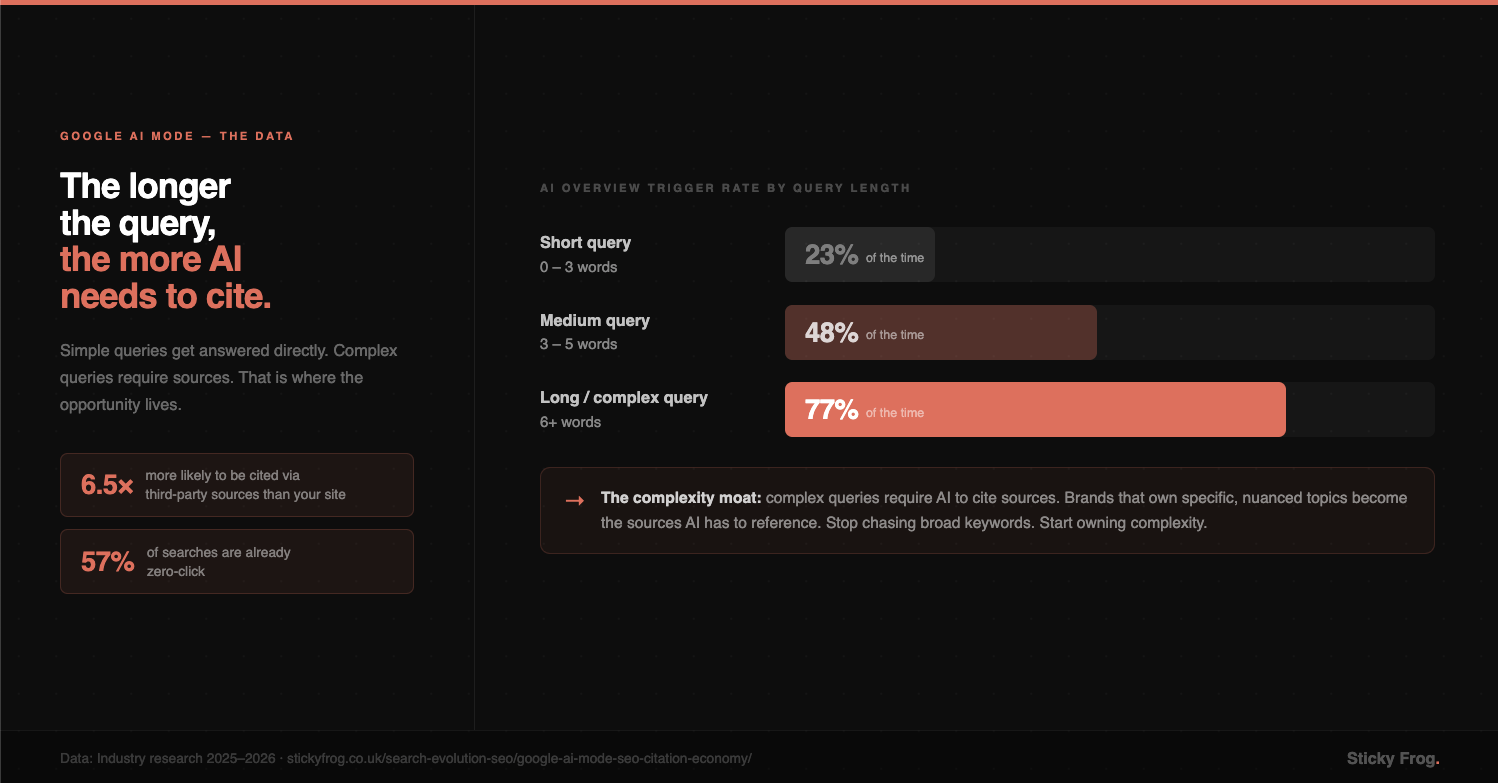
This creates what I would call the complexity moat. When someone searches “best CRM,” Google AI Mode can answer that directly without citing anyone in particular. The answer is general enough to synthesise without expert sources. But when someone searches “best CRM for enterprise SaaS companies managing remote sales teams across multiple regions,” AI Mode has to cite sources, because that question requires contextual expertise, real-world experience, and nuanced analysis that cannot be synthesised from generic content.
The strategic implication is significant. The brands building authority around specific, complex, multi-layer problems are building moats that generic AI synthesis cannot displace. Shallow content targeting broad high-volume keywords is increasingly worthless in an AI Mode world, not because it will not rank, but because it will not be cited, and citation is where the commercial value now lives.
This means the content strategy question has shifted from “what keywords do we rank for?” to “what complex problems do we own so completely that AI Mode cannot synthesise an answer without citing us?” That is a fundamentally different content brief, and it produces fundamentally different content. The Content Architecture guide covers how to build these depth clusters in practice.
How should you measure success if traffic is no longer the right KPI?
This is the measurement question that most marketing teams have not yet resolved yet, and it is creating a dangerous disconnect between what the SEO is achieving and what the board is seeing in analytics.
A brand can be performing exceptionally in the citation economy, appearing consistently in AI-generated answers, building recognition, influencing decisions at the moment queries are resolved, and show flat or declining organic traffic in Google Analytics. If traffic is the only KPI, that brand looks like it is failing when it is actually winning.
The metrics that matter in a citation economy are different from the metrics that mattered in a traffic economy. Branded search volume in Google Search Console is the most reliable leading indicator of AI-driven brand discovery, users who encounter your brand in an AI-generated answer frequently search for you directly afterwards. Rising branded search volume alongside stable non-branded traffic is the signature pattern of a brand performing well in AI Mode.
Direct traffic trends, share of voice in AI-generated answers through manual monthly testing, and featured snippet capture rate are all more meaningful than total organic session volume in the current environment. The full measurement framework for this is covered in How to Measure Search Visibility in 2026.
What is the authority tax and why can it not be hacked?
Authority is the foundation of the citation economy, and authority takes time. This is uncomfortable for teams that have been accustomed to SEO tactics that produce results in weeks. The authority tax is the investment, of time, consistency, and genuine expertise, that AI systems require before they consider a brand credible enough to cite.
AI systems evaluate authority through patterns: the same brand or author being referenced across multiple credible, independent sources over time. A brand that appears in three editorial mentions in respected publications, two podcast transcripts, a Wikidata entry, a well-structured Google Business Profile, and consistent LinkedIn thought leadership has a different authority profile to a brand that has published 200 articles on its own domain and nothing anywhere else. The former gets cited. The latter frequently does not.
The components of authority that AI Mode rewards are the same components that good SEO practitioners have been building for years under different names: off-site signals, brand mentions, editorial coverage, digital PR. What has changed is the weight these signals carry and the directness of their commercial impact. In the old model, off-site authority eventually fed into rankings which eventually generated traffic. In the citation economy, off-site authority directly determines whether you appear in AI-generated answers that resolve queries before a click happens.
This is the hardest message for teams to accept: there is no shortcut. You cannot buy citations. You cannot manufacture them through link schemes. You can only build them, through consistent publishing of genuinely expert content, active pursuit of editorial mentions, podcast appearances, industry contributions, and the structural entity signals (schema, Wikidata, consistent entity definition) that make AI systems confident enough to reference you. How to write an entity definition and Organisation schema implementation are the technical starting points.
What does the search everywhere shift mean for your strategy?
Google still processes the majority of searches, around 13.7 billion per day. But the search behaviour of buyers has fragmented significantly. Instagram, Amazon, TikTok, YouTube, and LinkedIn all process billions of searches daily. Each platform has its own AI-powered discovery layer. And each rewards the same underlying signals: authority, consistency, and depth.
The strategic insight is that the authority you build for Google AI Mode is not Google-specific. An entity that is clearly defined, consistently described, and widely referenced across credible platforms becomes recognisable to any AI system that processes information about that domain, regardless of which platform the query is made on.
Stay ahead of it.
Weekly intelligence for marketing leaders navigating the shift from SEO to AI retrieval. Practical, senior-level, no filler.
No spam. Unsubscribe any time.
This is why the off-site work covered in the Recognition Layer matters beyond Google: podcast appearances create indexed transcripts. LinkedIn thought leadership creates social authority signals. Guest articles in industry publications create editorial citations. Wikipedia and Wikidata entries create structured entity records. Together, these build the kind of omnichannel authority profile that AI systems across every platform can recognise and trust.
The brands that will dominate search five years from now are not necessarily the ones currently ranking highest on Google. They are the ones building distributed, consistent, credible authority right now, paying the authority tax before their competitors understand it is being charged.
What should you do about this now?
The shift to a citation economy does not require abandoning your existing SEO investment. Traditional SEO, technical foundations, content quality, backlinks, is not obsolete. It is the floor, not the ceiling. Without it, the citation economy work produces nothing. With it, the citation work compounds everything.
The practical priority sequence based on what I have observed across client accounts:
First, establish your entity foundation. Write your entity definition and deploy it consistently across your website, LinkedIn, Google Business Profile, and Wikidata. Implement Organisation schema on your homepage with sameAs links. This is the machine-readable identity that AI systems use to recognise and reference you.
Second, restructure your most important content for AI extraction. Answer-first openings, question-format headings, FAQ sections with schema markup. These changes make existing content extractable by AI systems that are already finding your pages.
Third, build the off-site recognition signals. Editorial mentions, podcast appearances, community contributions, guest articles. These are the distributed citations that validate your authority beyond your own domain.
Fourth, measure the right things. Branded search volume, AI citation rate through manual testing, featured snippet capture, direct traffic trends. Replace traffic volume as the primary KPI with metrics that reflect performance in a citation economy.
The complete framework for implementing all four of these layers is the Search Visibility Framework. The free Search Visibility Snapshot includes a manual test of how your brand currently appears in Google AI Mode, ChatGPT, and Perplexity, with specific recommendations for improving your citation rate.
Frequently Asked Questions
What is Google AI Mode?
Google AI Mode is Google’s AI-powered search experience that places an AI-generated answer at the top of search results, synthesising information from multiple sources and citing them below the response. It is designed to resolve user queries directly rather than directing users to a list of links. It represents a fundamental shift in Google’s model from a navigation tool to an answer engine.
How does Google AI Mode affect SEO?
Google AI Mode changes the primary objective of SEO from ranking for keywords to getting cited as a source in AI-generated answers. Brands that are cited receive visibility at the moment a user’s query is resolved, before a click is necessary. Brands that are not cited are invisible regardless of their ranking position. This creates a citation economy where recognised authority matters more than keyword optimisation.
What is the complexity moat in AI search?
The complexity moat is the strategic advantage built by owning specific, complex, multi-layer topics that AI cannot fully synthesise without citing expert sources. Long, complex queries trigger AI Overviews 77% of the time, compared to 23% for short queries. This means brands that build deep, authoritative content around complex problems are disproportionately likely to be cited in AI-generated answers for those queries.
Why is traffic no longer the right SEO KPI?
Traffic is an output of ranking position and click-through rate. In a world where AI Overviews answer queries before users click, rankings can remain stable while traffic falls, not because SEO has failed but because zero-click search has increased. Measuring performance by traffic volume alone produces misleading results. Branded search volume, AI citation rate, and direct traffic trends are more meaningful indicators of authority-building performance in the current environment.
How do you get cited in Google AI Mode?
Getting cited in Google AI Mode requires three layers of work. First, strong traditional SEO foundations so your content is indexed, ranking, and accessible to AI systems. Second, content structured for AI extraction, answer-first openings, question-format headings, FAQ schema, so AI can identify and retrieve relevant passages. Third, distributed off-site authority signals, editorial mentions, podcast appearances, industry citations, that give AI systems the external validation needed to consider your brand credible enough to cite.

Founder & Author within Sticky Frog and creator of The Human Algorithm. 15 years of SEO experience spanning early-stage startups, scale-ups, and enterprise brands including Toyota Europe, Bupa, EY, Citibank, Deliveroo, and American Express, he specialises in AI search visibility, entity SEO, and search strategy for the era where clicks are declining but influence is not. Get found for what you do best.