
Three numbers changed how I think about search strategy.
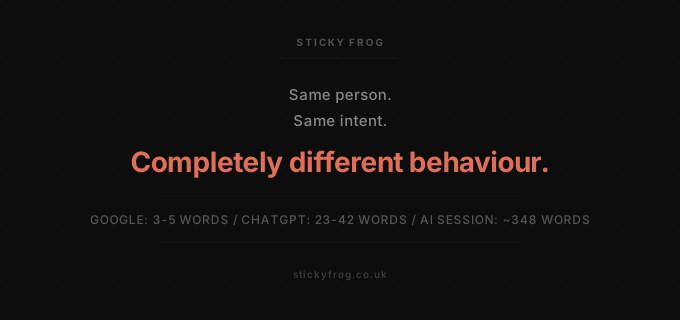
The average Google search query: 3 to 5 words.
The average ChatGPT prompt: somewhere between 23 and 42 words, depending on the study.*
The average AI conversation session: approximately 348 words of back and forth.
Same person. Same intent. Completely different behaviour.
That gap, between 4 words and 348, is not a technical footnote. It is the most significant shift in information-seeking behaviour since Google replaced the directory. And most content strategies have not accounted for it at all.
*Sources: Metehan Yesilyurt, analysis of 1,827 real ChatGPT prompts via Google index and Archive.org; Semrush prompt behaviour study; Trippas et al. AI conversation research. Cited in Searchable webinar, March 2026. Exact figures vary by study and methodology, but the directional finding is consistent across all sources: AI prompts are substantially longer, more contextual, and more intent-rich than traditional search queries.
I came up in search the long way. Small startup sites where you did everything yourself. Agency life inside some of the largest SEO teams in the world, working on brands like Toyota Europe, Citibank, Bupa, EY, Deliveroo, Digital Spy, Square, and American Express. Watching search evolve from keyword stuffing to semantic search, from ten blue links to featured snippets, from position one to AI-generated answers.
Every shift I have lived through followed the same pattern. The brands that adapted earliest did not just survive the transition. They pulled away from the field while their competitors were still debating whether anything had really changed.
What is different this time is not the scale of the change. It is the nature of it.
Previous algorithm updates changed how content was ranked. This one changes how information is consumed. The destination has moved. And the map most brands are using was drawn for somewhere else.
The Search Behaviour Nobody Is Building Content For
When someone types a keyword into Google, they are signalling a topic.
When someone opens ChatGPT and describes their situation, their team size, their budget, their constraints, their specific problem, they are starting a conversation.
A keyword is an input. A prompt is a disclosure.
The same person who searches “CRM software” on Google will ask ChatGPT: “I run a five-person SaaS team, no dedicated sales ops, roughly fifty pounds per user per month budget. What CRM would you recommend and why?”
That is not a search query. That is a brief.
And AI treats it like one. It draws on every source it associates with authority on that topic, synthesises an answer, and presents it as a recommendation. Your brand is either part of that answer or it is not. There is no page two. There is no position four. There is cited, and there is invisible.
The question that should sit at the centre of every content strategy right now is not “how do we rank?” It is: when our buyer describes their problem to an AI, are we the answer?
Most brands do not know. Most have not started finding out.
What Changed Was Never Really the Algorithm
Here is the thing about every major search shift I have observed.
The algorithm did not lead. The human did.
Google did not invent the preference for authoritative content. It responded to the fact that people were clicking away from thin pages. Mobile-first indexing did not create the demand for fast, readable content on phones. It followed behaviour that was already there. Featured snippets did not manufacture the desire for immediate, direct answers. They surfaced it.
The algorithm has always been downstream of human behaviour.
Which means the question to ask right now is not “what does the AI reward?” It is: what does the person actually need, in the context they are actually in, in the language they actually use?
Answer that clearly, consistently, and at depth, and the visibility follows.
That has always been true. It is more true now than it has ever been.
Stay ahead of it.
Weekly intelligence for marketing leaders navigating the shift from SEO to AI retrieval. Practical, senior-level, no filler.
No spam. Unsubscribe any time.
Start With Root Identity
Before any content strategy. Before any prompt mapping. Before any keyword research or topic clustering.
Define what your brand fundamentally is.
Not your services. Not your positioning statement. The irreducible thing.
Three to five words that capture your brand at its most essential.
HubSpot: CRM platform. Slack: workplace messaging. Xero: small business accounting software.
Sticky Frog: AI search visibility consultancy.
This matters for a precise reason.
AI systems build understanding through pattern recognition. They associate brands with topics through the consistency and frequency of that association across sources: your website, your LinkedIn, your third-party mentions, your schema markup, your Wikidata entry.
If your root identity is inconsistent across those sources, if your homepage says one thing, your LinkedIn says another, and your Google Business profile says a third, the AI has nothing reliable to pattern-match against.
Clarity of identity is not a branding exercise. It is a retrieval signal.
The Topic Tree: From Identity to Depth
Once the root identity is defined, you build outward systematically.
Think of your content territory as a tree. The root identity is the base. From it grow first-level branches, your main categories or services. From each branch grow child topics, the specific, granular, answerable areas within each category.
The goal is 10 to 30 core topics across your branches. Not questions. Topics. Because topics generate questions, and questions become prompts.
One topic, handled well, can underpin 40 or 50 distinct pieces of content.
“GEO for B2B brands” alone produces:
“What is generative engine optimisation and how does it differ from SEO?”
“How do I know if my brand is being cited in AI search results?”
“Which content formats are most likely to be retrieved by large language models?”
“How long does it typically take to build AI search visibility?”
The leverage is not in answering individual questions. It is in owning the topics that generate the questions, so that as the conversation evolves, your brand is already there.
The Three People in Every Buying Decision
Content strategy tends to imagine a single buyer.
But most purchase decisions, certainly in B2B and increasingly in considered B2C, involve multiple people at different stages asking categorically different questions.
Consider a marketing team evaluating an SEO partner.
The analyst or executive has a day-to-day problem:
“How do I track whether our content is appearing in AI Overviews?”
“What tools exist for monitoring AI search visibility?”
The manager is researching solutions:
“What is the difference between traditional SEO and AI search optimisation?”
“Which agencies specialise in GEO strategy?”
The director or CMO signs off on investment:
“What is the business case for AI search visibility?”
“How are brands in our sector approaching this?”
Each of those is a different prompt. Each requires different content. Each represents a different moment in the decision-making process.
A content strategy that serves only one of those three people is, by definition, invisible to the other two, and invisible to two thirds of the conversation that leads to a sale.
Go Vertical
The brands that build durable AI visibility do not just go deep on their topic tree.
They go vertical.
Every industry has its own prompt universe, its own specific language, its own particular problems, its own version of the questions you are equipped to answer.
“AI search visibility” becomes:
AI search visibility for professional services firms.
AI search visibility for e-commerce brands.
AI search visibility for SaaS companies.
AI search visibility for healthcare providers.
Each vertical generates its own set of prompts. Each has a buyer who uses slightly different language and comes to the conversation with a different set of assumptions.
The brands that appear in AI answers are not simply the most authoritative in their category. They are the most relevant to the specific context in which the question is being asked.
Relevance in context is the new ranking factor.
Classify Intent Before You Build Content
Not all prompts are the same. Content built for the wrong intent stage is invisible regardless of quality.
Every prompt maps to one of three stages.
Learn
Someone at the early stage, building understanding.
“What is generative engine optimisation?”
This requires foundational content: explainers, frameworks, definitions, guides.
Consider
Someone evaluating options and comparing approaches.
“Best AI search visibility agency for B2B technology brands.”
This requires proof: case studies, comparisons, specific outcomes, named methodologies.
Purchase
Someone ready to act, needing specifics to commit.
“AI visibility audit pricing UK.”
This requires clarity: pricing, process, what to expect, how to start.
The consistent failure pattern I see in content audits is heavy investment in Purchase-stage content and thin or absent Learn and Consider content.
The problem with that pattern is structural. AI is where people go to learn and to explore, not just to buy. If you are absent at the Learn stage, you do not enter the consideration set. If you are absent at the Consider stage, you do not reach the purchase conversation.
The funnel has not disappeared. It has moved into conversations. And it still requires you to be present at every stage.
Not sure which intent stage your content covers? Get a free AI Visibility Snapshot and find out.
Five Ways to Find the Prompts Your Buyers Are Already Using
The prompts exist. The work is in finding them.
Ask the AI directly. Take any topic and ask: “What questions would someone have about this topic?” You will receive 10 to 20 real, specific, contextual questions within seconds. These are not invented. They are surfaced from actual patterns in how people interact with AI.
Mine People Also Ask. Every PAA entry is a real question from a real user. They translate directly into prompt-ready content briefs.
Read Reddit, Quora, and sector forums. The language communities use when they discuss problems is the language those same people use when they prompt AI. It is the most accurate signal available for how your buyers phrase their needs, before anyone has sanitised it into a keyword.
Use People Also Search For. This surfaces adjacent topics, the areas sitting just outside your current content territory that your buyers are also exploring.
Review your own data. Support tickets. Sales call notes. Chatbot logs. Live chat transcripts. These are verbatim prompts from people who have already found you. They are the most precise signal of all, and the most consistently overlooked.
The Complete Build
A prompt strategy is not a content calendar. It is a structural asset.
Built once, maintained over time, it gives you a clear picture of every topic you need to own, every content piece mapped to an intent stage and a stakeholder, every vertical accounted for, and every gap between you and your competitors identified.
- Root identity defined: 3 to 5 words, consistent across all platforms
- Topic tree built: root, first-level branches, child topics
- 40 to 60 themes generated across your key categories
- Themes expanded into specific prompts
- Prompts classified by intent: Learn, Consider, Purchase
- Prompts prioritised by relevance, value, and competitive gap
- Stakeholder map complete: end user, evaluator, decision-maker
- Verticals identified and mapped to topic tree
- Competitor gap matrix complete
- On-page content plan built by intent stage
- Off-page citation opportunities identified: Wikidata, Clutch, sector publications
- Entity signals consistent across site, LinkedIn, Google Business, schema
- Tracking and measurement plan in place
Want this built for your brand? Start with a free AI Visibility Snapshot and we will show you exactly where the gaps are.
The Constant Beneath the Change
Every algorithm update I have worked through, and there have been many, has eventually resolved to the same underlying truth.
The brands that endure are the ones that understand the person behind the query.
Not the query. The person.
Their context. Their role. Their actual problem. The language they use when they are not talking to a search engine. The question they would ask a trusted colleague rather than type into a box.
AI has not changed this. It has made it more visible.
The prompt is not a more sophisticated keyword. It is a window into what the human actually needs: unfiltered, contextual, specific.
Build for that, and you build something that outlasts any algorithm.
Before the algorithm changed, there was always a human.
There still is.

Founder & Author within Sticky Frog and creator of The Human Algorithm. 15 years of SEO experience spanning early-stage startups, scale-ups, and enterprise brands including Toyota Europe, Bupa, EY, Citibank, Deliveroo, and American Express, he specialises in AI search visibility, entity SEO, and search strategy for the era where clicks are declining but influence is not. Get found for what you do best.