
How the shift to agentic search is rewriting the rules for every small and medium business.
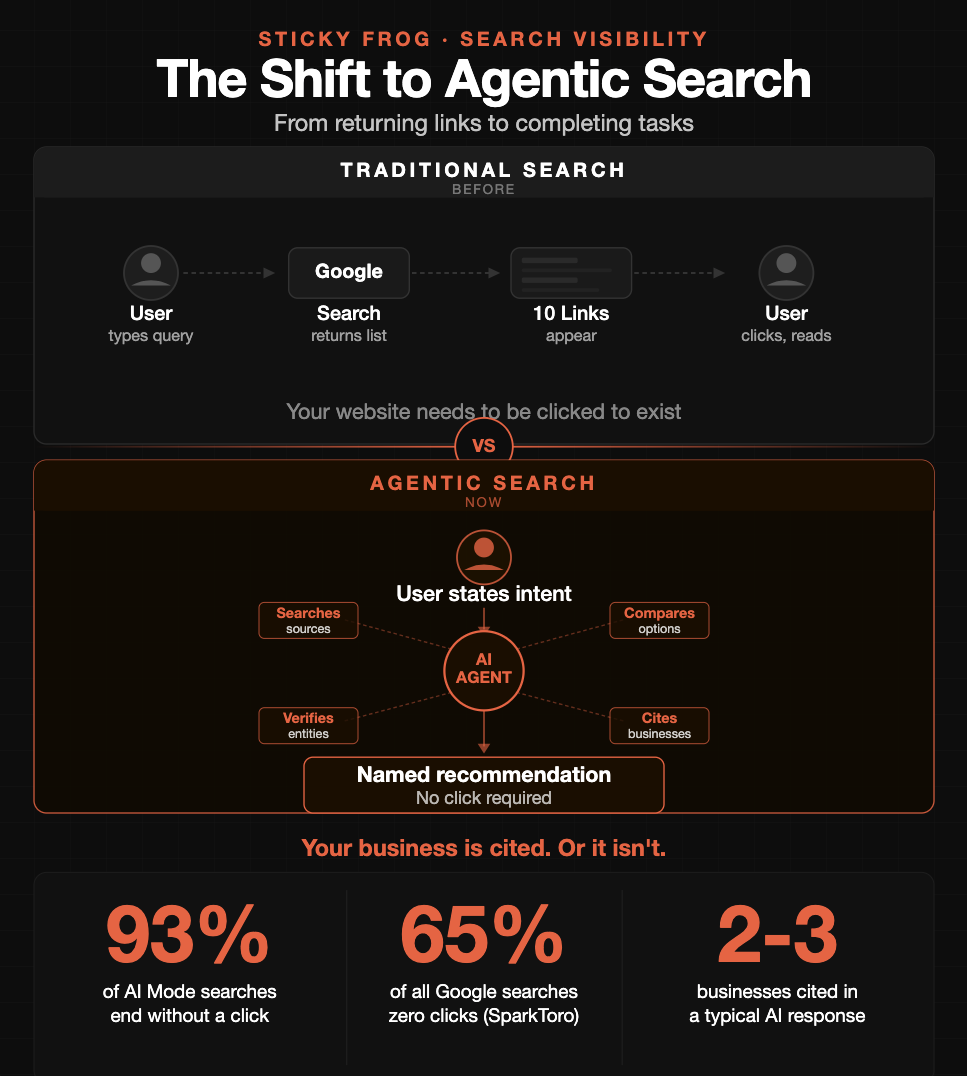
Around 93 percent of AI Mode searches end without a click to any website. Not 30 percent. Not half. Ninety-three. And that is before most business owners have even registered that AI Mode exists. There is a moment happening in search right now that most of them have not clocked yet. Not because it is subtle, but because the people who should be talking loudly about it are too busy selling last decade’s strategy.
Here is the truth: Google is no longer primarily a search engine. It is becoming an agent. And that changes everything about how your business gets found, recommended, and chosen.
This is not a prediction. It is not a trend report dressed up as insight. This is what is unfolding in real time, and the businesses that understand it in the next six to twelve months will be in a very different position to the ones that do not.
From Finding to Doing
Search is no longer a retrieval system. It is becoming an execution system, one that completes tasks on behalf of users rather than presenting them with a list of options to evaluate.
For twenty-five years, search worked in one direction: a person typed something in, Google returned a list of links, and that person clicked one. Your job as a business was to be near the top of that list.
That model is ending.
Google’s own CEO, Sundar Pichai, has said publicly that the future of search is agentic. Instead of handing you a list of options, Google’s AI will start completing tasks on your behalf. Booking the restaurant. Comparing the insurance quotes. Finding the accountant. Requesting the quote. Scheduling the call.
The user asks. The agent acts.
Google is already rolling this out through what it calls AI Mode, an evolution of search that goes far beyond the AI Overviews you may have noticed appearing above results. AI Mode does not just summarise; it takes action. It browses. It reasons across multiple sources. It makes decisions.
And that 93 percent figure is the number every business owner needs to sit with. The AI finds what it needs, answers the query, takes the action, and your website never even gets visited. If your business is not being cited inside that AI response, you do not exist in that interaction.
Why This Hits Small and Medium Businesses the Hardest
Small and medium businesses face a specific problem with agentic search. The three channels they have historically relied on, local search, Google rankings, and word-of-mouth verification, are being disrupted at the same time.
Large brands have had SEO teams and content departments for years. They have built digital authority slowly, and that authority is now what AI systems lean on to decide what to recommend.
If you run a boutique consultancy, a local professional services firm, a specialist retailer, or a founder-led service business, you have likely relied on that combination of channels to stay visible. Local search is shifting to AI-generated recommendations that do not always pull from the same signals Google Maps used to rely on. Google rankings matter less when the answer appears before the results, or when there are no traditional results shown at all for a given query. Word of mouth still matters enormously, but increasingly when someone is told about your business and goes to verify it, the first thing they are doing is asking an AI. What does that AI say about you? Can it find you? Does it recommend you? Or does it recommend your competitor, because they structured their content in a way that AI can actually parse?
This is the new reality. And it is happening now, not in three years.
Working across health content at Bupa, the principle we returned to consistently was precision over volume. Content in that category had to be specific, sourced, and demonstrably expert, not because it was pleasant to write that way, but because the systems evaluating it demanded it. What those standards required then, AI systems now require of all content across every sector. The bar has moved to meet everyone.
What Agentic Search Actually Means for Your Business
Agentic search means AI generates a named recommendation rather than a list of links. A prospective client asking an AI to find the best consultant in your sector gets back two or three specific names, not ten options to evaluate. Whether your business is one of those names is determined before the user ever opens the interface.
Let us make this concrete.
Imagine a potential client, a marketing director at a forty-person company in Manchester. She has been told by her MD to find an SEO consultant who understands AI search. She opens ChatGPT, Perplexity, or Google’s AI Mode and types: “Who are the best SEO consultants in the UK for businesses moving into AI-driven search?”
The AI does not open fifty tabs and cross-reference them. It draws on a web of indexed content, citations, entity data, and structured information to generate a confident, named response, often with just two or three recommendations.
Is your business in that response?
If you do not know the answer, that is the problem. And if the answer is no, it is not because your work is not good. It is because your digital presence was not built to be read by machines, only by humans. The shift to agentic search has created a new visibility layer, one that lives above traditional search results and is driven by very different signals than the ones most businesses have optimised for.
According to SparkToro’s 2024 zero-click research, 65 percent of Google searches were already ending without a click to any website before the current expansion of AI-generated responses. The direction of travel is not ambiguous.
The Three Signals That Determine Whether AI Finds You
Three signals determine whether AI systems cite your business in a response: how machine-readable your content is, how consistently your business is represented across the web, and how specifically your expertise is demonstrated. The businesses winning in agentic search have all three. Most businesses have none.
Stay ahead of it.
Weekly intelligence for marketing leaders navigating the shift from SEO to AI retrieval. Practical, senior-level, no filler.
No spam. Unsubscribe any time.
Structured, machine-readable content
AI agents do not experience your website the way a human does. They do not see your hero image or respond to your brand voice in a paragraph. They parse structure, headings, schema markup, and the clarity of your claims. If your website reads beautifully to humans but is structurally vague, with broad service descriptions, generic copy, and no clear topical authority, AI systems will struggle to know what you actually do and who you actually serve. They will not cite what they cannot confidently describe.
Consistent entity presence
When an AI is deciding whether to cite your business, it is cross-referencing your presence across multiple sources: your website, press mentions, directories, reviews, social profiles, and the language used about you across the web. This is your entity footprint. Businesses with a strong, consistent entity footprint get cited. Businesses that exist only on their own website, with little third-party reinforcement, get overlooked. The AI is not just reading you. It is checking whether anyone else corroborates what you say about yourself.
Demonstrable, specific expertise
The era of broad, generic content is over. AI systems are trained to identify actual expertise through original thinking, specific claims, and demonstrated experience. A page that says “we help businesses grow with expert SEO strategies” tells an AI agent almost nothing. A page that says “we help founder-led professional services firms gain citations in AI-generated search responses through entity SEO and structured content” tells it everything it needs to know. Specificity is the new authority.
If you want to understand exactly where your business sits across all three of these signals right now, the free AI Visibility Snapshot at stickyfrog.co.uk is the starting point. No commitment. A clear picture of where you stand.
The Mistake Most Businesses Are Making Right Now
The most common mistake I see is waiting.
Business owners are watching their organic traffic dip and assuming it is a temporary algorithm adjustment. SEO agencies are continuing to sell the same keyword strategies they have sold for a decade, wrapping them in AI language but not actually changing the underlying work.
The obvious counterargument here is that AI search is still a small share of overall traffic, and that traditional Google results still drive most discovery. That is true today. But it is the same logic that kept businesses off mobile until it was the dominant device, and off social discovery until the early positions were already claimed. By the time the new channel is dominant, the window to establish authority ahead of the competition has closed. Authority builds slowly and compounds. Waiting for certainty means starting late.
The businesses that establish their agentic visibility now, that build their entity authority, structure their content for machine readability, and get cited by AI systems while most competitors are still invisible, will have a compounding advantage that becomes very difficult to challenge later.
Authority takes time to build. That is true in traditional SEO. It is doubly true in the agentic web. If you are waiting for this to be fully mainstream before you act, you will be acting in a market where all the early positions have been claimed.
What Getting Ready Actually Looks Like
Improving your agentic search visibility does not require starting over. It requires understanding your current baseline, identifying where competitors have not yet established authority, and making your existing expertise legible to AI systems in a way it currently is not.
The fundamentals of good content, genuine expertise, and a well-structured website still matter. They are just table stakes now. What is needed on top of that is a deliberate strategy for the new layer of search.
The starting point is understanding where you currently stand. Before you can improve your agentic visibility, you need to know your baseline. Which queries does AI associate you with? Where are you cited, and where should you be but are not? What does your entity footprint actually look like across the web? Most businesses have never asked these questions because the answers were not previously visible. Now they are, and the gap they reveal is often significant.
From there, the next step is identifying the gaps your competitors are exploiting. In most sectors right now, almost everyone is invisible in agentic search. But that will not last. The businesses that conduct a proper diagnostic now will see exactly where the opportunity is: the queries their competitors have not claimed, the topics where a first-mover could establish real authority before anyone else does.
Building content and structure that AI can use follows from that. This is not about gaming a system. It is about becoming genuinely, demonstrably useful to AI, which means being specific, being structured, and being cited elsewhere for the right things. And underpinning all of it are the technical foundations: machine readability, site architecture, schema markup, page speed. Not exciting, but the infrastructure layer that makes everything else work.
I have noticed this in everything that requires real reps to get right. Training my dog springs to mind as a direct correlation, continue the same patterns and it eventually becomes natural. The same is true in search strategy. Fifteen years of doing this work means I can look at a business’s digital presence and understand fairly quickly where the visibility is leaking. Not from a report. From pattern recognition. And right now, the pattern I see most consistently is businesses that are genuinely good at what they do, but whose presence was built for a search landscape that no longer fully exists.
The Question to Ask Yourself
If someone asked an AI right now to recommend a business like yours, in your category, serving your type of client, in your location, would your name come up?
If you are not sure, or you suspect the answer is no, that is exactly the conversation worth having.
The shift to the agentic web is the biggest change in how customers find businesses since Google replaced the Yellow Pages. The businesses that treat it seriously in 2025 will look very smart in 2026. The ones that wait will be explaining to their clients why their visibility collapsed.
Before the algorithm changed, there was always a human trying to find an answer. There still is. The only thing that has changed is the system they are trusting to find it for them.
Start with a free AI Visibility Snapshot at stickyfrog.co.uk and find out exactly where your business stands.
Frequently Asked Questions
What is agentic search and how is it different from regular Google?
Agentic search describes AI systems that complete tasks on behalf of users rather than returning a list of links for the user to evaluate. Where traditional Google surfaces options and expects the user to click and decide, agentic search makes the recommendation or takes the action directly. Google’s AI Mode is the most significant current example, and Google’s CEO has described the long-term direction of the company explicitly in those terms.
Why are businesses seeing their organic traffic drop even when they haven’t changed anything?
When Google resolves a query inside its own interface through AI Overviews or AI Mode, fewer users click through to external sites. The query gets answered without a visit. SparkToro’s research found that 65 percent of searches were already ending without a click before the current expansion of AI responses. For businesses that relied on organic traffic as a primary lead source, the result shows up as a decline that has no obvious explanation in their own activity.
How does AI decide which businesses to recommend?
AI systems build their recommendations by aggregating signals across many sources: the structure and specificity of a business’s own content, external citations and mentions, reviews, directory listings, and the consistency of how the business is described across different platforms. A business that is clearly and consistently described across multiple sources is more likely to be cited than one that exists primarily on its own website with little external reinforcement.
What is an entity footprint and why does it matter for AI search?
Your entity footprint is the collective record of your business across the web: how you are described on your own site, what third-party sources say about you, what reviews exist, and how consistently your name, services, and expertise appear across different platforms. AI systems use this cross-web presence as a verification layer. A business with a strong, consistent entity footprint is one that AI can cite with confidence. A business with a thin or inconsistent footprint is one AI tends to overlook.
Do I need to rebuild my website to become visible in AI search?
In most cases, no. The website is rarely the primary problem. The more common gaps are imprecise content that does not clearly communicate what the business does and who it serves, a thin external presence with few third-party citations, and a lack of topical specificity that would allow AI systems to associate the business with a defined area of expertise. These are content and strategy problems, not design problems.
Is this only relevant for large businesses with big SEO budgets?
No, and the opportunity is often greater for small and specialist businesses than for large enterprises. AI systems reward specificity, depth, and cross-verified expertise, all qualities that genuine specialists tend to have in abundance. The challenge for small businesses is not a lack of expertise. It is making that expertise legible to AI systems. That is a focused, solvable programme of work, and it does not require enterprise-scale resource to do well.
How long does it take to improve AI search visibility?
Structural content improvements can produce measurable changes in AI retrieval within four to eight weeks. Entity depth and topical authority tend to build over three to six months, in a pattern similar to traditional entity SEO. The businesses starting this work now are building a position that will be harder to challenge as the market matures. Starting later means starting in a more competitive landscape.
What should I do first if I want to understand my AI search visibility?
The most useful starting point is an honest assessment of where you currently stand. Open ChatGPT, Perplexity, and Google’s AI Mode and search for what a prospective client would type to find a business like yours. Note what appears and what does not. That gap between how you appear and how you should appear is the starting point for everything else. The free AI Visibility Snapshot at Sticky Frog provides a more structured version of that assessment at no cost.
How is this different from what my current SEO agency is doing?
Most SEO agencies are still primarily optimising for traditional ranking signals: keyword positioning, backlink volume, and on-page technical factors. These matter, but they address a different layer of visibility to the one AI systems use to generate responses. Agentic visibility requires structural content precision, entity presence across the web, and topical specificity that can be attributed. Some traditional SEO work contributes to this. Much of it does not. A diagnostic that assesses all three layers will show you where the gaps are.
Start with a free AI Visibility Snapshot at stickyfrog.co.uk

Founder & Author within Sticky Frog and creator of The Human Algorithm. 15 years of SEO experience spanning early-stage startups, scale-ups, and enterprise brands including Toyota Europe, Bupa, EY, Citibank, Deliveroo, and American Express, he specialises in AI search visibility, entity SEO, and search strategy for the era where clicks are declining but influence is not. Get found for what you do best.