
From Matching Words to Mapping Expertise
Entity SEO is the strategic process of structuring your brand so that search systems understand who you are, what you do, and which topics you are genuinely authoritative about. Unlike traditional SEO, which optimises individual pages for keywords, Entity SEO builds a recognised identity, one that AI systems and search engines can confidently retrieve and cite.
For a deeper look at how AI systems build their knowledge maps, read The Entity Layer: Why AI Systems Prioritise Brands Over Web Pages.
For two decades, SEO was a game of linguistic precision. If you wanted to rank for “enterprise software,” you used “enterprise software” in the right places with the right frequency. Search engines matched strings of text. The page was the unit of value.
That model has not disappeared. But search has graduated from word-matching to knowledge-mapping, and the brands that understand this shift are building visibility that compounds. The ones that do not are optimising for a version of search that is shrinking.
What Is Entity SEO?
Entity SEO focuses on strengthening the association between two things: your brand (the entity) and the specific topics you want to be known for. In the context of AI-driven discovery, the stronger this association, the more likely your content is to be retrieved as a trusted source.
We are moving from ranking pages to establishing recognised expertise. The difference matters enormously for how you allocate your marketing effort.
How has search shifted from keywords to entities?
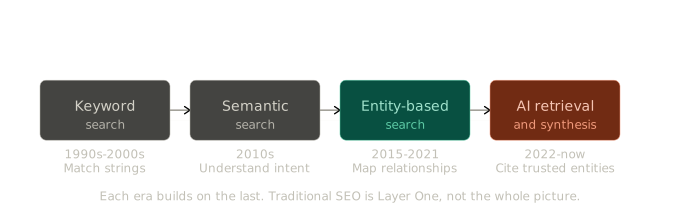
Search engines have spent over a decade building Knowledge Graphs: multi-dimensional maps that connect real-world objects rather than matching text strings. Modern search interprets meaning by identifying relationships between entities.
A founder started a company. A brand specialises in an industry. An expert created a framework. When a user types a query, the system looks for the entity that provides the best context, not just the page that contains the most matching words.
This is a fundamental architectural change, not an incremental update to the old model.
Why does Entity SEO matter now more than ever?
Three forces are accelerating the shift:
AI-powered synthesis. Tools like ChatGPT, Gemini, and Perplexity do not return a list of links. They synthesise an answer from multiple credible sources. To be included in that synthesis, your brand needs to exist as a recognised knowledge node with clear topic associations.
The Authority Graph. Search engines maintain an internal map of expertise. When your brand consistently appears in connection with specific topics across trusted environments, your node in that graph grows stronger. This is how authority becomes machine-readable.
Discovery fragmentation. Search no longer happens exclusively on Google. Reddit, LinkedIn, industry newsletters, and AI interfaces all contribute to discovery. Visibility now depends on whether your entity is recognised across the web, not just whether one URL ranks on a single platform.
What are the three core signals of Entity SEO?
I. Entity Clarity
The machine needs to know precisely who you are. This requires a consistent identity: unified brand naming, clear author attribution that meets Google’s E-E-A-T guidelines, identifiable leadership, and structured data (schema markup) that labels your entity clearly for search systems.
Without entity clarity, even excellent content is difficult for AI systems to attribute confidently.
II. Topic Association
You need to be known for something specific. Search systems observe patterns: which concepts appear repeatedly alongside your brand across independent sources. A consultancy that consistently publishes on AI retrieval and entity authority eventually becomes the canonical reference for those topics in the machine’s understanding.
This is why publishing original frameworks and named methodologies has such disproportionate impact. You force the citation rather than allowing it to be shared with every other voice in the category.
III. Distributed Mentions
Stay ahead of it.
Weekly intelligence for marketing leaders navigating the shift from SEO to AI retrieval. Practical, senior-level, no filler.
No spam. Unsubscribe any time.
Authority is socially validated. If multiple independent, credible sources, including podcasts, industry publications, and professional communities, reference your entity, your credibility is reinforced across the knowledge graph. Every mention outside your own domain is a signal.
This is the Recognition Layer: the filter AI systems use to decide which sources are widely acknowledged as credible. Brands that exist only on their own website lack the cross-platform signals the machine needs to trust them.
How does Entity SEO differ from traditional SEO?
| Traditional SEO | Entity SEO | |
|---|---|---|
| Focus | Optimising pages | Building entity authority |
| Unit | Keywords and backlinks | Topic associations and citations |
| Metric | Search rankings | Discovery recognition |
| Arena | Your website | The entire web ecosystem |
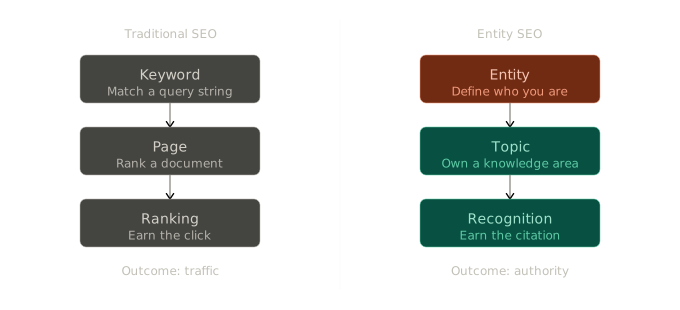
The strategic implication is significant. Traditional SEO builds a destination. Entity SEO builds a reputation. In an era where the majority of AI discovery happens without a click, being the destination is no longer enough. You need to be the brand the AI assumes is the answer before it finishes processing the query.
What should marketing teams do first?
Start with the foundation: implement Organisation schema on your homepage, write a consistent entity definition that you use across every platform you appear on, and build the external references, LinkedIn, Google Business Profile, industry directories, that tell search systems you are a real, established, credible brand.
Then structure your content for retrieval. Content that opens with a direct answer, uses question-format headings, and includes FAQ sections is significantly more likely to be cited than content written as a traditional narrative article.
The goal has evolved. It is no longer: “how do we rank this page?” It is: “how do we ensure the internet recognises us as the only logical source for this answer?”
Start with a free Search Visibility Snapshot to see how your brand currently appears across all three layers of modern search. Or read the Search Visibility Framework for the complete strategic picture.
Frequently Asked Questions
What is Entity SEO?
Entity SEO is the practice of structuring your brand so that search systems understand who you are, what topics you are authoritative about, and how you relate to other entities in your field. It shifts the focus from individual pages and keywords to building a recognised, retrievable identity across the web.
How is Entity SEO different from traditional SEO?
Traditional SEO optimises individual pages for specific keyword queries. Entity SEO builds the underlying recognition that determines whether your brand appears in AI-generated answers, knowledge panels, and discovery results. Traditional SEO is about ranking documents. Entity SEO is about being recognised as an authority.
What is a Knowledge Graph in SEO?
A knowledge graph is a structured database that search engines use to map relationships between real-world entities. It connects people to organisations, organisations to topics, and topics to each other. Search engines use knowledge graphs to understand what a query is really asking for, not just which words it contains.
How do I start building entity authority for my brand?
Begin with three steps: implement Organisation schema markup on your homepage with a clear entity definition, build consistent profiles across LinkedIn, Google Business Profile, and industry directories, and publish original content that consistently associates your brand with specific topics. Each of these creates signals that search systems can verify and trust.
Why do some brands appear in AI answers and others do not?
AI systems retrieve from sources they recognise as credible entities within a specific topic area. Brands that appear consistently across multiple independent sources, with clear topic associations and structured entity signals, are significantly more likely to be cited. It is not primarily about content volume or domain authority. It is about recognition.

Founder & Author within Sticky Frog and creator of The Human Algorithm. 15 years of SEO experience spanning early-stage startups, scale-ups, and enterprise brands including Toyota Europe, Bupa, EY, Citibank, Deliveroo, and American Express, he specialises in AI search visibility, entity SEO, and search strategy for the era where clicks are declining but influence is not. Get found for what you do best.